Getting started
Replacing a front lawn with a native garden in Omaha: a first-season plan
A practical, season-by-season plan for turning part of an Omaha front lawn into a native planting bed — removing turf, choosing plants for full sun and clay, and keeping it tidy enough for the neighbors.

By Amanda Kupsti
· Updated · 8 min read
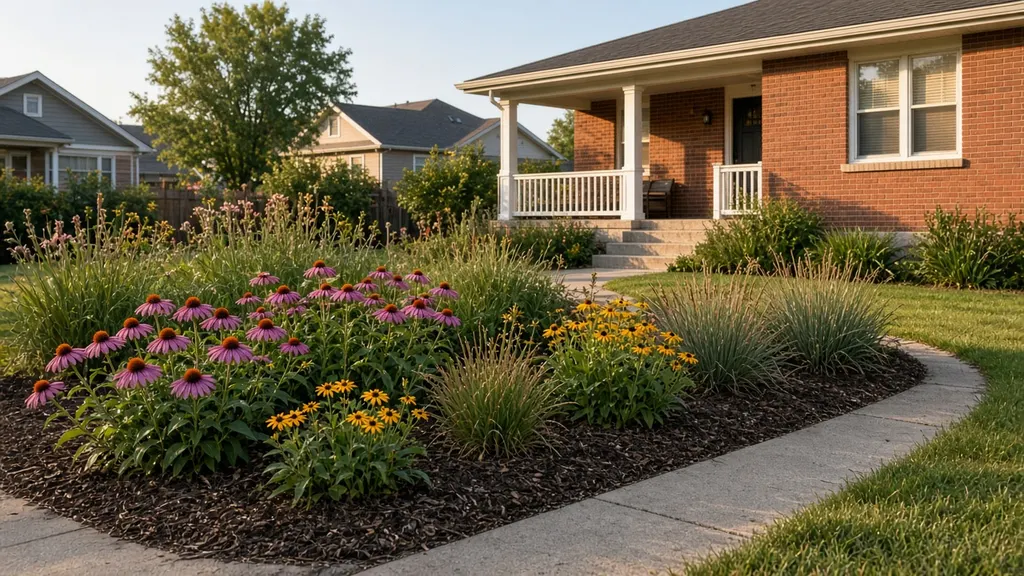
Most of the people who ask me about native gardens in Omaha are not trying to build a prairie. They have a front lawn that struggles every August, a water bill they would rather not think about, and a vague sense that the yard could be doing more. They want something that looks intentional from the street, that does not take over their weekends, and that will still be alive after a January with a week below zero.
That is a very achievable goal, and it does not require tearing out the whole lawn. This guide walks through the plan I use for a first season: how big to start, how to remove turf without chemicals or a rented sod cutter if you would rather not, which plants to lean on, and what the bed should look like at the end of year one. If you only take one thing away, make it this: start smaller than you think, and finish the edges.
Why start with part of the lawn
A front yard is the most visible part of a property, and it is the part most likely to draw comments from neighbors and, occasionally, from the city. A small, clearly defined bed reads as a garden. A whole yard of young plants in their first summer can read as a yard nobody is mowing. Plants that are native to eastern Nebraska spend much of their first year growing roots rather than leaves — the old saying is "the first year they sleep, the second they creep, the third they leap" — so a large planting looks thin for longer than most people expect.
Starting with one bed also lets you learn your own site. You will find out where water sits after a storm, which corner bakes against the driveway, and how much time you actually want to spend weeding. Those lessons make the second bed better and cheaper.
A small bed with a crisp edge looks like a decision. A large bed of seedlings looks like an accident. Start with the decision.
How big is "small"?
For most Omaha front yards I suggest starting with something between the size of a parking space and the size of a one-car garage. Big enough to make a visible difference from the sidewalk, small enough that you can weed the whole thing in a single evening.
| Starting size | Good for | What to expect |
|---|---|---|
| Parking-space sized | Busy households, rentals, first-time gardeners | One weekend to prepare, easy to water by hand in year one |
| One-car-garage sized | Most front yards with a few hours a month to spare | A clear "garden" look by the second summer |
| Half the lawn or more | People who already garden and have help | Plan for more watering and weeding in year one; consider doing it in phases |
Step one: read the site before buying anything
Before choosing a single plant, spend a week paying attention to the spot you have in mind. Note how many hours of direct sun it gets, whether it is near a downspout, whether snow from the driveway gets piled on it in winter, and whether there are utilities underneath. Call 811 before you dig — it is free and required in Nebraska before excavation, and a front strip is exactly where buried lines tend to run.
- Sun: Six or more hours of direct sun counts as full sun. Most of the plants below want that.
- Water: Watch it after a heavy rain. Standing water for more than a day changes the plant list.
- Salt and snow: Beds next to a driveway or sidewalk get plowed snow and de-icing salt. Leave a buffer strip or choose tougher plants for that edge.
- Sight lines: Keep plants near the driveway and corners low so you can still see traffic when backing out.
If your soil is the heavy, sticky clay common across much of the metro, read my guide to planting in Omaha clay soil before you start amending — the short version is that you usually need to amend far less than you think.
Step two: remove the turf
There are three common ways to take out lawn grass. None of them is wrong; the right one depends on your timeline and how much physical work you want to do.
| Method | Timeline | Effort | Notes |
|---|---|---|---|
| Sheet mulching (cardboard + mulch) | Start in fall for spring planting | Low | Smothers grass in place; plain brown cardboard, tape removed |
| Solarizing with clear plastic | 6–8 weeks of summer heat | Low | Works best in July and August; looks rough while it runs |
| Cutting sod by hand or machine | One or two days | High | Fastest; removes some topsoil with the roots |
My default for a front yard is sheet mulching in the fall. Mow the grass as short as your mower allows, lay plain cardboard with generous overlaps so no light gets through, soak it, and cover it with two to three inches of shredded hardwood mulch. By April, the grass underneath has mostly given up and the cardboard has softened enough to plant through. It looks like a freshly mulched bed all winter, which keeps the neighbors happy.
If you are starting in spring and want to plant the same season, cutting the sod is the faster route. Flip the cut sod upside down in a back corner and it will break down into usable soil within a year.
Step three: choose a short plant list
The most common mistake in a first native bed is buying one of everything. A bed of forty different plants, each represented once, looks busy and random. A bed of five or six kinds, each planted in groups, looks designed.
For a sunny Omaha front yard on clay, these are the plants I lean on most. They are native to the region, widely available at local native plant sales and nurseries, and forgiving of a first-year gardener.
| Plant | Height | Bloom | Role in the bed |
|---|---|---|---|
| Purple coneflower (Echinacea purpurea) | 2–3 ft | Early to late summer | Long-blooming color, seedheads for winter birds |
| Black-eyed Susan (Rudbeckia hirta / fulgida) | 1.5–2.5 ft | Mid to late summer | Fast filler, bright from the street |
| Little bluestem (Schizachyrium scoparium) | 2–3 ft | Grass; copper fall color | Structure and movement; the "glue" between flowers |
| Prairie dropseed (Sporobolus heterolepis) | 1.5–2 ft | Fine grass; fragrant late summer | Tidy, rounded edging grass |
| Aromatic aster (Symphyotrichum oblongifolium) | 1.5–2 ft | Fall | Late color when everything else is fading |
| Butterfly milkweed (Asclepias tuberosa) | 1.5–2 ft | Early summer | Orange color; host plant for monarchs |
Heights vary with site and soil, so treat these as typical ranges rather than promises. For plants that keep the bed interesting outside summer, see designing a native garden for four seasons.
Plant in groups, and use grasses as the frame
Plant flowers in groups of three, five or seven, and run grasses along the front edge and between the groups. The grasses hold the composition together when the flowers are not blooming, and a front row of a single low grass — prairie dropseed is my favorite for this — gives the bed a finished border.
Step four: plant at the right time
In Omaha, the best planting windows are mid-April through early June and again from late August through September. Spring planting gives roots a full season; late-summer planting takes advantage of cooler nights and warm soil. Avoid planting in the middle of July unless you are prepared to water every day or two.
Small plugs — plants in pots a couple of inches across — are the best value. They establish faster than people expect and catch up with larger potted plants within a season or two. Space most perennials 12 to 18 inches apart; it will look sparse the first year and full by the third.
Step five: the first-season routine
The first year is when a native bed needs the most help. After that, the work drops off sharply.
Weeks 1–3
Water every two or three days unless it rains. Keep the soil around new plugs moist, not soggy.
Weeks 4–8
Water deeply once a week in dry spells. Pull weeds while they are small — every week or two.
Midsummer
Expect little top growth; roots are developing. Water only in extended dry periods.
Fall
Leave stems and seedheads standing. Top up mulch where it has thinned.
A first-year maintenance checklist
- Walk the bed once a week and pull anything you did not plant
- Water deeply in dry stretches, at the base of the plants
- Keep the edge crisp — re-cut it in late spring and midsummer
- Mark plant locations with small tags so you do not weed out slow starters
- Leave stems standing over winter for birds, insects and snow-catching structure
- Take photos in June, August and October so you can see progress next year
Rabbits will find it
Every Omaha gardener eventually meets the neighborhood rabbits. Young plugs of asters, coneflowers and many other natives are a favorite snack in spring. Lightweight wire cages over new plants for the first few weeks go a long way. I cover this in more depth, including deer in the edges of town, in keeping rabbits and deer out of a native garden.
Keeping it neighbor-friendly
A native front garden should look like a garden, not a vacant lot. A few habits help a lot:
- Keep a mowed strip of lawn or a defined edge between the bed and the sidewalk.
- Add one "cue of care" — a bench, a birdbath, a small sign, a boulder — that signals someone tends this space.
- Repeat plants rather than mixing many kinds, so the bed has a clear pattern.
- Keep plants off the sidewalk and away from sight lines at driveways and corners.
- Check your city's current rules for plant height near sidewalks and streets; they do change, and they differ between Omaha and nearby cities.
What year one should look like
At the end of the first season, you should have a clearly edged bed, mulched paths between young plants, and a handful of blooms — coneflowers and black-eyed Susans often flower in the first summer. You will not have a lush meadow yet. That arrives in year two and three, as roots settle and plants fill their space.
When you are ready for a second bed, a pollinator patch in a corner is a natural next step; a small-yard pollinator garden shows how to fit one into very little space. And if you would rather have a plan drawn up for your site, my services page explains how that works.
Last updated
Related guides
Working with a designer
What a garden design plan includes — and what affects what it costs
What you typically get from a residential garden design plan, the difference between a consultation, a planting plan and a full design, and the factors that make one project cost more than another.
· 7 min read
Design
A pollinator garden for a small Omaha yard: what to plant and how to lay it out
How to fit a useful pollinator garden into a small city yard, patio edge or side strip in Omaha — bloom sequence, host plants, sun and part-shade lists, and simple layouts.
· 7 min read
Plants
Keeping rabbits and deer from eating your native garden in Omaha
Which native plants rabbits and deer tend to leave alone, how to protect new plantings, and simple fencing and timing strategies that work in Omaha neighborhoods and edge-of-town yards.
· 7 min read